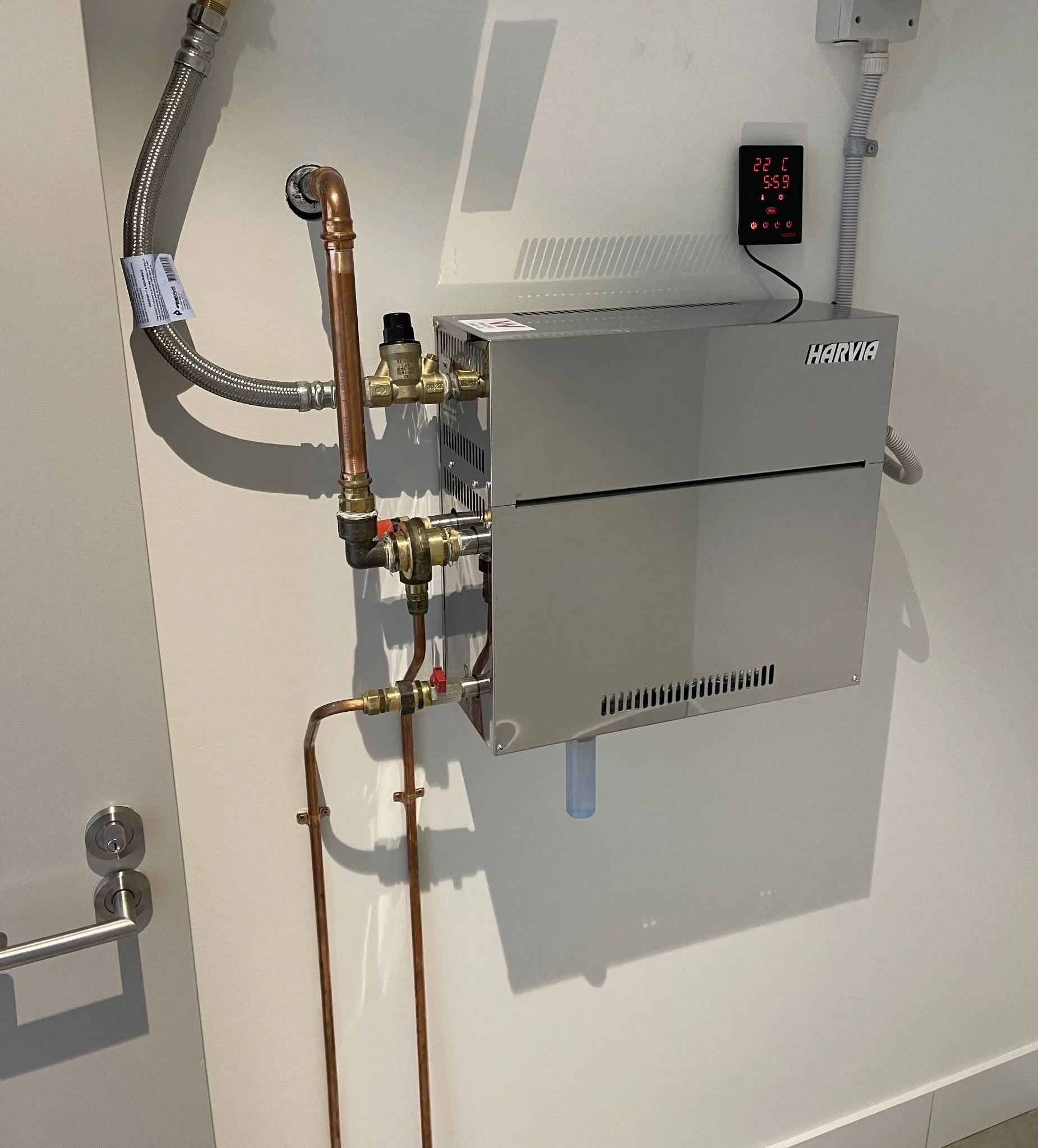
Steam generators, sized for the room.
Residential and commercial steam generators, selected for the room’s materials, located for reliability and set up for easy servicing. We are the Queensland agent for Harvia.
Sizing
Volume is only half the calculation.
A steam generator boils water outside the room and pipes steam to an outlet low in the room, cycling to hold the set temperature. How much output it needs depends on the room volume and on what the room is built from: stone, tile on masonry, glass and external walls all need considerably more than tile on an insulated board.
Corrections vary widely between manufacturers, so we size from the selected brand’s own tables using the actual build-up, glass areas and external walls — and confirm the ventilation approach, because sealed and ventilated rooms are sized differently.
Location
Where the generator goes matters.
- 01
Ambient temperature
Harvia limits the air temperature around its generators to 30 °C; other makers set their own limits, such as 35 °C or 45 °C, and the selected model’s manual governs. Hot roof spaces and closed cupboards are best avoided.
- 02
Pipe run
Maximum steam-pipe lengths vary by manufacturer. The pipe is insulated and laid to fall without dips that trap condensate.
- 03
Drainage
Water drained from the generator is very hot and never discharges into the steam room. A drain in the plant space is planned in.
- 04
Service access
Clearances for draining, descaling, sediment removal and element replacement, plus space for a water softener where needed.
Water quality
Scale is the most common cause of trouble.
Hard water leaves scale on elements and level sensors, leading to poor output, fault codes and early element failure. Manufacturers recommend testing the water before installation and fitting a softener where hardness exceeds their limits; some require softening for public facilities.
Automatic draining and flushing after each session, and descaling at the interval the manual sets for your water and hours of use, keep a generator reliable for the long term. Flushing reduces scale; it does not replace descaling or servicing.
Where an installation needs it, we supply suitable water filtration or treatment equipment, sourced in Australia and chosen for the generator and the water at the site.
Compliance and licensed trades
Questions
Common questions
Why does the room’s finish change the generator size?
Dense materials such as stone, concrete and tile on masonry absorb a great deal of heat before they warm up, and glass and external walls keep losing heat. Until those surfaces warm, steam condenses on them rather than heating the air, so heavier rooms need more output. Each manufacturer applies its own correction.
Is a bigger generator always better?
No. Some manufacturers set a minimum room volume for each model, and an oversized generator can make a room uncomfortable. The generator is sized from the selected brand’s own tables with accurate details of the build-up, glass and external walls.
How is a steam generator maintained?
Many generators can drain and flush automatically after use (on Harvia generators this needs the optional automatic discharge valve), so power is left on after a session for these cycles to run. Descaling intervals are set by operating hours and water hardness in each manufacturer’s manual. Commercial generators are typically professionally serviced on a set schedule.
Further reading
- Sizing a steam generator: why room volume isn't enoughWhy steam generator size depends on finishes, glass, ceiling height, exterior walls, starting from cold and hours of use, not room volume alone.
- Steam generators and water quality in South East QueenslandHow scale forms in a steam generator, how hard SEQ water is, what Harvia's water table asks for, and the flushing, descaling and servicing that prevent it.
- Steam room design and constructionHow a steam room is built — enclosure and door, vapour control, finishes and heat-up, ceiling slope, outlet and sensor, drainage, lighting and ventilation.
Already own one?
Size a generator with us.
Send us the room dimensions, finishes and glass areas — or the make and model of an existing generator — and we will recommend the right equipment and plant arrangement.