The short answer
A sauna has two kinds of timber surface, and they should be chosen differently.
- Benches, backrests and headrests — anything your skin touches — need timber that is low in density, free of knots and free of resin. Aspen, thermally modified aspen, alder and clear western red cedar are the usual choices.
- Walls and ceilings can be chosen more for appearance. Western red cedar (clear or knotty), Nordic spruce, hemlock and thermally modified species all work well.
Get those two decisions right and the room will be comfortable, stable and easy to look after.
What we use
Most of the saunas we build are lined in western red cedar, with clear grades wherever skin touches. We sometimes use Canadian hemlock when a paler, almost scent-free room is wanted. Our species comparison sets out the strengths and trade-offs of cedar, hemlock and the other legitimate sauna timbers.
The timbers at a glance
Each of these is an established sauna timber. The last column is what we actually do, so you can see where our experience lies.
| Timber | Best suited to | Character | At BSC Wellness |
|---|---|---|---|
| Western red cedar | Walls, ceilings, and benches in clear grade | Warm brown tones, strong natural aroma, very stable, naturally durable | Our principal timber, used in most of the saunas we build |
| Canadian hemlock | Walls and ceilings; benches in clear grade | Pale, even and almost scent-free | Used sometimes, where a paler, quieter room is wanted |
| Aspen and thermo-aspen | Benches and backrests; also walls | Pale and odourless, or golden and very stable when thermally modified | Not used routinely; happy to discuss |
| Alder and thermo-alder | Benches and backrests; also walls | Fine, even grain and a warm tone that deepens with age | Not used routinely; happy to discuss |
| Abachi (ayous) | Benches | Very light, pale and cool to the touch | Not used routinely; happy to discuss |
| Nordic spruce | Walls and ceilings, not seats | The classic Finnish lining: pale and usually knotty | Not used routinely; happy to discuss |
| Thermally modified timber | Benches, walls and ceilings | Darker, very stable and resin-free, with a mild smoky scent | Not used routinely; happy to discuss |
For densities, movement, resin and an honest list of strengths and trade-offs side by side, see Sauna timbers compared.
Why some timber feels cooler to sit on
Every surface in a sauna heats towards the temperature of the air. Timber is comfortable at 80 °C or more not because it stays cool, but because it passes heat to your skin slowly — far more slowly than tile, stone or metal at the same temperature.
How slowly depends mainly on two things:
- Density. Lighter, more open timber conducts less heat. This is why low-density species are used for benches, and why dense hardwoods feel uncomfortably hot.
- Moisture. Drier timber conducts less heat. Sauna timber should be properly kiln-dried and kept dry between sessions.
Knots matter for the same reason. They are denser than the surrounding wood and usually contain more resin, so they can feel hotter and may bleed resin when heated. That is why bench timber should always be clear grade.
Benches and backrests
Benches carry the most wear, the most moisture and direct skin contact, so they are where timber choice matters most.
| Timber | Character | Consider |
|---|---|---|
| Aspen | Pale, even, odourless, resin-free | Shows sweat and water marks; benefits from towels and occasional oiling |
| Thermally modified aspen | Golden to mid-brown, very stable, resin-free | Mild smoky scent; slightly more brittle, so bench ends should be sealed |
| Alder / thermo alder | Fine, even grain; warm tone that deepens with age | Slightly denser than aspen; thermo alder hides marks well |
| Clear western red cedar | Among the lightest common species, very stable, aromatic | Soft, so dents more easily; distinctive scent |
| Abachi | Very light and pale; a long-standing European bench timber | Australian supply should be confirmed early; ask for certified timber |
Whatever the species, good benches are also a matter of detailing: rounded edges, concealed stainless fixings driven from underneath, enough board thickness and support for the span, and sections that lift out for cleaning and drying.
Walls and ceilings
Wall and ceiling timber sets the character of the room. The main options:
- Western red cedar — warm brown tones, a strong natural aroma and excellent stability. Available clear or knotty.
- Nordic spruce — the traditional Finnish lining: pale and fine-grained. Usually knotty; choose a grade with small, tight knots.
- Hemlock — pale, even and almost odourless, a good neutral choice. Specify a clear grade.
- Thermally modified spruce, pine or aspen — darker, very stable and resin-free.
The ceiling is the hottest part of the room, so low-density species are preferable there, and resinous knotty pine or spruce directly above the heater is best avoided.
Specify the botanical name
Trade names are inconsistent. “Canadian red cedar” is western red cedar (Thuja plicata) — not a true cedar, and not Australian red cedar. “Canadian hemlock” is sold under two different species names, and “Nordic redwood” is Scots pine. Specifying the botanical name and grade avoids surprises.
Clear or knotty?
Clear timber is knot-free or very nearly so. It costs more and gives a calm, contemporary finish. It is essential for benches and backrests.
Knotty timber has sound, tight knots and a more traditional, rustic character. It is perfectly acceptable on walls and ceilings and is often chosen to manage budget — but keep it away from anything you sit or lean on.
Thermally modified timber
Thermally modified (“thermo”) timber is heated to around 180–220 °C in a low-oxygen kiln, without chemicals. The process changes the wood permanently:
- More stable. It takes up less moisture, so it swells and shrinks considerably less.
- Resin-free. Resin is driven out during treatment, so there is no bleed in the heat.
- Lower heat transfer. The ThermoWood industry handbook reports thermal conductivity 20–25% lower than untreated softwood.
- Darker colour throughout, which hides marks well.
There are trade-offs worth understanding:
- It is more brittle. The ThermoWood handbook reports splitting strength reduced by 30–40%, so benches need adequate board thickness, supported spans, rounded edges and sealed ends.
- It has a scent. A mild smoky aroma that fades over time. Some makers say it never disappears entirely, so scent-sensitive clients should try a sample.
- It is not for structural use. Bench frames should be designed accordingly.
- It is not termite-resistant. The ThermoWood handbook and Lunawood, a Finnish producer, both say so.
For busy rooms and for a richer, darker interior, thermally modified aspen and alder are widely used bench timbers.
Aroma
Scent is a matter of taste, and it is worth deciding early. Western red cedar has the strongest and longest-lasting aroma, which many people associate with a real sauna and some find too much. Hemlock, aspen, alder and abachi are close to scent-free. Thermally modified timber carries a faint smoky note that fades over time. If you are unsure, smell an offcut before committing to a whole room.
How sauna timber ages
Every sauna timber darkens with heat, light and use, and a well-used room should look lived-in rather than new. Benches mark first, where people sit and lean. Western red cedar deepens towards honey and brown; pale timbers such as aspen and hemlock show use sooner; thermally modified timber hides it better because it starts darker. Outdoors, unprotected timber weathers to silver-grey, faster in strong sun.
Finishes and care
- No varnish or lacquer on benches, walls or ceilings inside the hot room.
- Benches may be treated with a sauna-specific paraffin oil or wax a few times a year to resist staining. Oiling deepens the colour, so test it on the underside first.
- Choose one system per surface. Sauna oils and waxes are not interchangeable: Tikkurila, for example, makes its sauna paraffin oil for benches only, and says its sauna wax should not go over oiled timber. Read the product data sheet before treating anything.
- Walls can be left untreated or finished only with products made for saunas. Sources differ here; follow the timber supplier’s instructions.
- Dry the room after use — typically by running the heater briefly with the vent open and the door ajar — and use towels on benches. Light sanding removes most marks.
Our care guide covers cleaning, bench oil and what not to use.
Commercial rooms
In hotels, gyms and wellness clubs, benches take far more use than in a home. Timber choices should favour stability and serviceability:
- Clear western red cedar for its stability and light, comfortable feel; or thermally modified aspen or alder, which are stable and dark enough to hide marks, with sealed ends.
- Removable, replaceable bench slats so worn sections can be renewed without rebuilding.
- Robust, concealed stainless fixings and generous support.
- A cleaning regime matched to the timber, using products the supplier approves.
Compliance and licensed trades
In commercial and multi-residential buildings, wall and ceiling linings may be subject to National Construction Code fire hazard requirements. Overseas fire ratings quoted for timber products are not Australian classifications. Timber selection for these projects should be confirmed with the project’s designer and building certifier, and heater clearances to timber must always follow the heater manufacturer’s instructions.
What about Australian hardwoods?
Spotted gum, jarrah and blackbutt are beautiful and durable, but they are more than twice the density of western red cedar. Inside the hot room that density means they pass heat to skin much faster, so they are uncomfortable to sit or lean on. They belong outside the hot room — on the exterior of an outdoor sauna, decks, change rooms and cold-plunge surrounds — where their durability is a real advantage.
Charring the surface (the Japanese shou sugi ban or yakisugi finish) does not change this. A charred hardwood board is still a dense hardwood board. Treat charred boards and dense hardwoods as exterior materials for a sauna. Our outdoor sauna guide covers exterior cladding in Queensland conditions.
Profiles and board sizes
Once the species and grade are chosen, the board’s profile (the shape of its edges and face) decides how the wall looks up close, how it is fixed and how it copes with movement. Profile is easy to overlook on a drawing and very obvious in a finished room.
The common profiles
| Profile | What it is | Where it is used |
|---|---|---|
| Tongue-and-groove | Each board has a tongue on one edge that locks into a groove on the next. Often with a small V or rounded chamfer at the joint | The standard sauna wall and ceiling lining |
| Sauna “STP” and softline profiles | Tongue-and-groove boards made for sauna linings, usually with rounded edges and a narrow groove between broad faces. Makers use their own names for these profiles | Walls and ceilings where a soft, even surface is wanted |
| Shiplap and channel | Each board’s edge overlaps the next, leaving a stepped joint or a recessed channel | More common on exterior cladding; used inside for a stronger shadow line |
| Square-edge battens | Plain rectangular boards or slats fixed with a gap between them | Bench slats, backrests, feature walls and ceiling battens |
Why the profile matters
- Movement. Timber swells and shrinks as its moisture content changes, and a sauna swings from cool and humid to very hot and dry. Tongue-and-groove and overlapping profiles let each board move without opening a visible gap. The Western Red Cedar Lumber Association says its channel profile “allows for dimensional movement” for this reason.
- Fixing concealment. Tongue-and-groove boards can be fixed through or over the tongue, so the next board hides the fixing. One thermally modified timber maker specifies stainless clips and staples for its sauna panels. Concealed stainless fixings keep metal away from skin and stop iron staining the timber.
- Shadow lines. A deep V-joint or channel draws a strong line at every board; a softline profile with a narrow groove reads as an almost continuous surface. Neither is better. It is a design choice that should be made early, because it changes the character of the room.
- Cleaning. Every joint is somewhere for dust and moisture to settle. Smooth, rounded profiles with shallow joints are easier to wipe down than heavily grooved or rough-sawn ones, which is worth weighing in a busy commercial room.
Typical board sizes
There is no single standard. These ranges are what suppliers publish for their own products, and they are given only to show the usual order of size:
| Source | Product | Published size |
|---|---|---|
| Thermory (Estonia) | STP sauna wall panel, thermally modified aspen | 12 to 15 mm thick, 65 to 120 mm wide (55 to 110 mm cover) |
| A Czech sauna timber supplier | Aspen STP sauna profile | 15 × 90 mm, about 77 mm visible face |
| An Australian sauna timber supplier | STP sauna wall boards | 15 × 90 mm |
| Western Red Cedar Lumber Association | Western red cedar tongue-and-groove (siding) | 1 inch nominal, finished at 11/16 to 3/4 inch (about 17 to 19 mm); 4, 6 or 8 inch nominal widths |
Two points follow from these numbers. First, sauna lining boards are generally thinner than exterior cladding: the lining does not carry load, and the room’s framing, battens and insulation sit behind it. Second, the cover width (the face you see once the boards interlock) is always smaller than the board’s full width, so quantities and setting-out are calculated from the cover width.
Bench boards are a different matter. They carry people and span between supports, so they are thicker and are sized against the support spacing. Our guide to sauna benches and heat layers covers bench construction and the board thicknesses manufacturers recommend.
Vertical or horizontal boards?
Both work, and the choice is mostly visual:
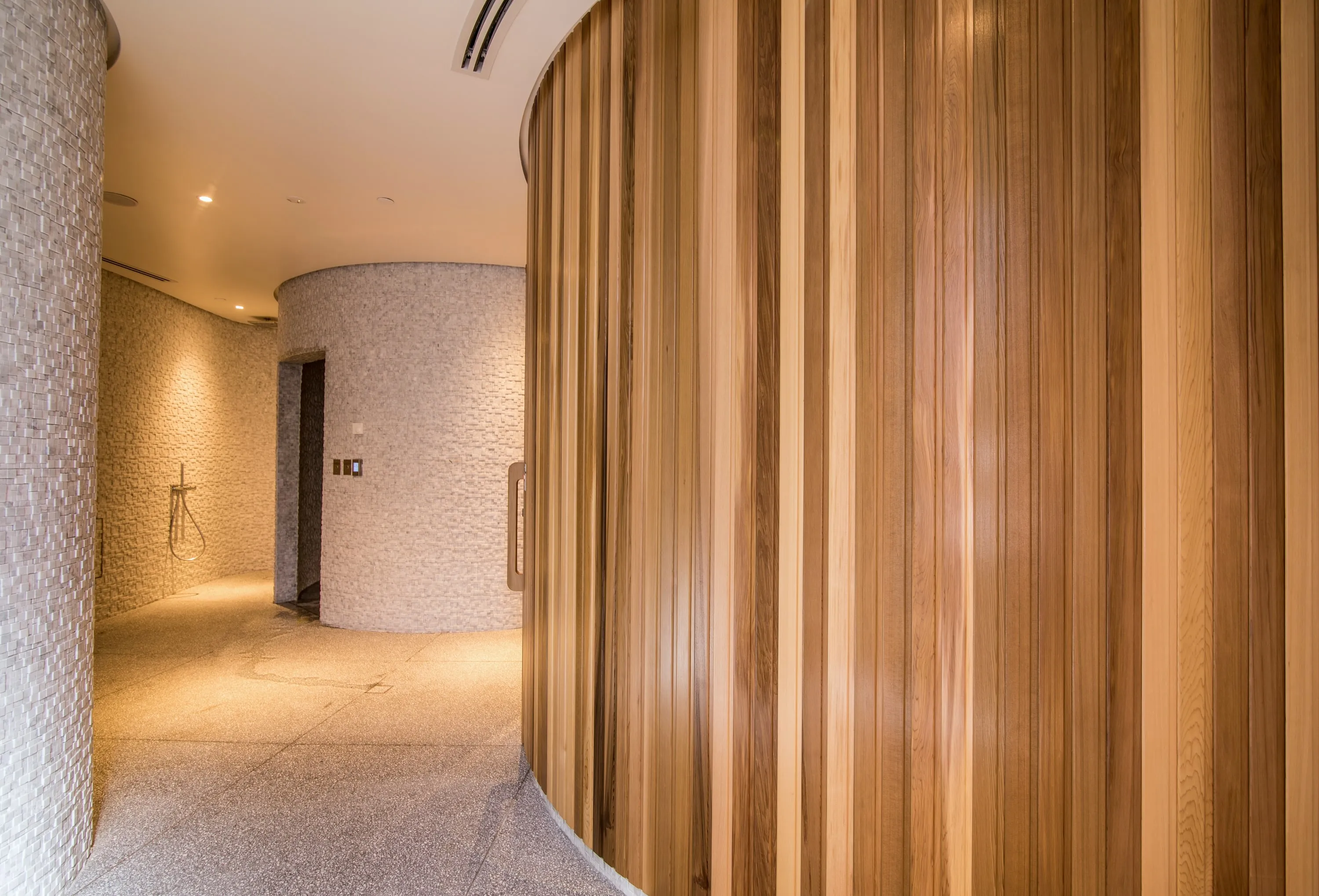
- Vertical boards draw the eye upward and suit tall rooms and curved walls, where narrow boards can follow the curve.
- Horizontal boards make a room read wider and are the traditional Finnish look.
Whichever way the boards run, the battens behind them run across them. One manufacturer’s sauna panel guide asks for battens at least 20 × 45 mm, at about 400 mm centres and no more than 600 mm apart, and for horizontal boards to be laid tongue up. Laid that way the joint sheds water instead of holding it in the groove. The panel maker’s instructions for the chosen product govern.
Specifying sauna timber
For architects, designers and builders, a good timber specification includes:
- Species by botanical name, and the grade (clear or knotty) for each element.
- Moisture content at delivery, appropriate for interior sauna use, and time for the timber to acclimatise on site once wet trades are complete.
- Certification — FSC or PEFC chain of custody where available.
- Non-staining fixings — stainless steel throughout. Iron fixings stain cedar blue-black.
- Battens and an air gap behind the lining, with bench loads carried by framing rather than by the panelling.
- Sealed bench end grain, particularly on thermally modified timber.
- Dust control in fabrication. Cedar, abachi and thermally modified timber dust are known irritants or sensitisers for the people machining them — a workshop matter, not a risk to bathers.
How we approach it
Timber is best decided early, alongside the heater, lighting and ventilation, because each affects the others. If you have plans or a concept, we can recommend a species and grade for each element of the room.