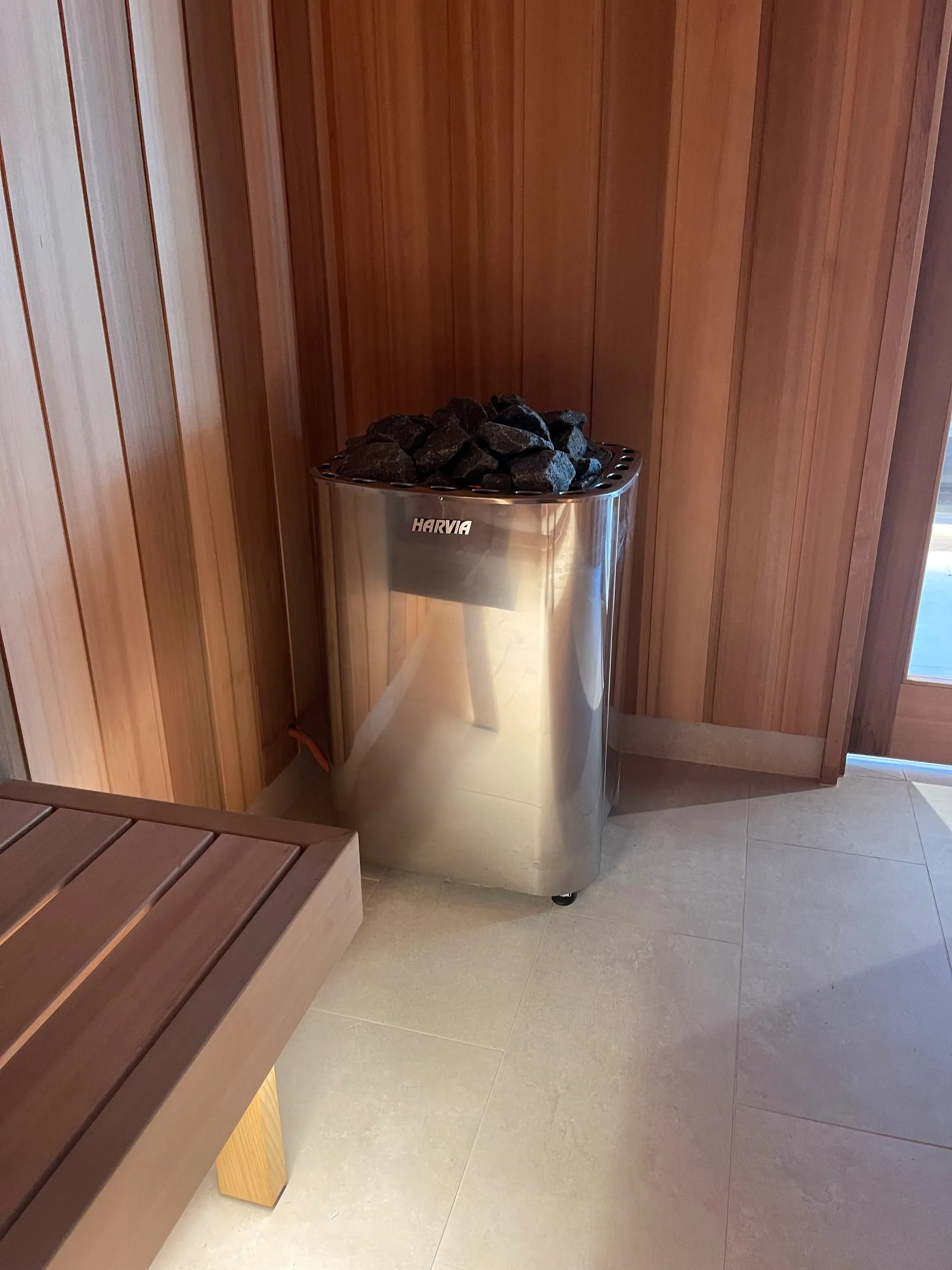
The heart of the sauna.
Harvia heaters selected, sized and installed for each room, with the stones and controls that make them perform. We are the Queensland agent for Harvia.
Sizing
A heater suits a room, not a price point.
Every heater is rated for a range of room volumes. Within that range, the right model depends on the room’s surfaces — glass, tile and masonry lose or absorb heat and add to the effective volume — and on how quickly and how often the room will be used.
An undersized heater runs constantly and struggles to reach temperature. An oversized one heats harshly and cycles on and off, and some manufacturers set a minimum room volume for each model. Sizing is done from the manufacturer’s own data.
Heater types
Four broad families.
- 01
Wall-mounted
Compact heaters fixed to the wall, suiting smaller rooms where floor space is precious.
- 02
Floor-standing
Free-standing heaters with a larger stone load, a common choice for family and larger rooms.
- 03
High stone-mass
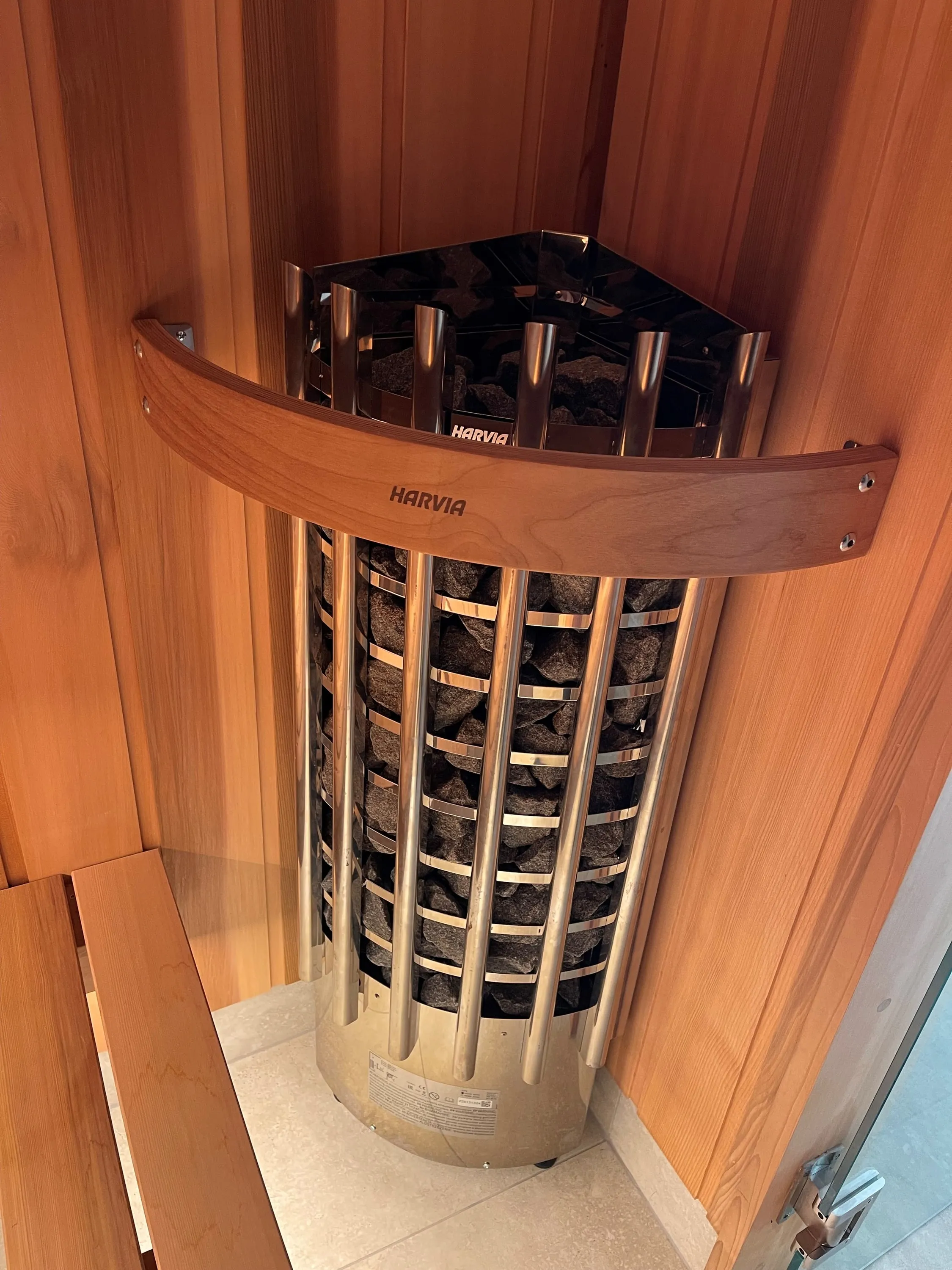
Tower and heat-storage designs holding a large mass of stones for a softer, more even heat and generous steam.
- 04
Concealed and combination
Heaters set into benches or walls, and combination heaters with an evaporator for softer, more humid sessions.
- 05
Commercial duty
Heaters rated for the long hours of gyms, hotels and wellness facilities, often with heavier stone loads and easier service access.
- 06
Wood-burning
Stoves for outdoor and off-grid saunas, with the flue, clearances and floor protection specified for the site.
Stones and steam
More stone, softer heat.
The stones store heat and turn water into steam — the burst of humidity known as löyly. Heaters with a larger stone mass tend to give a softer, more even heat and generous steam, at the cost of a longer heat-up.
- Larger stone mass gives gentler, longer-lasting löyly
- Stone mass helps the room recover after the door opens
- Bigger stone loads take longer to heat
- Clearances and guards are set by each heater manual
Room volume calculator
How big is your sauna, to a heater?
Heaters are rated for a range of room volumes, and glass and hard surfaces count extra because they take more heat. This uses Harvia's published method: the room's volume, plus 1.2 m³ for each square metre of glass or uninsulated tile, brick, concrete or stone, and 1.5 times the volume for an uninsulated log-walled room.
Other brands use different allowances, and the heater's own manual governs. We confirm the heater for your room.
Sauna stones
Small stones, important job.
- 01
Use only sauna stones
Stones supplied for sauna heaters resist repeated heating and water. River, garden or decorative stones can crack or shatter and are not safe.
- 02
Stack loosely
Air must flow around the elements. Stones are placed loosely, never packed tight, and never cover the elements in a way the manual prohibits.
- 03
Restack and replace
Stones crumble over time. Harvia asks for restacking at least yearly, more often with frequent use; heavily used commercial heaters need checking far more often. Follow your heater’s manual.
- 04
Watch for the signs
Longer heat-up times, crumbling fragments and stones settling onto the elements are signs a heater needs its stones renewed.
Compliance and licensed trades
Questions
Common questions
How is a sauna heater sized?
By room volume, within each model’s rated range, with an allowance for glass, masonry and other uninsulated surfaces. The allowance varies by manufacturer — one widely used range adds about 1.2 m³ of volume for each square metre of glass or masonry. Final sizing always follows the selected heater’s documentation.
How long does a sauna take to heat?
Harvia gives about an hour for a correctly sized heater in a properly insulated room, with the stones reaching temperature at about the same time; glass, large rooms and heaters with a very large stone load take longer, and other makers’ figures vary by model. Some heat-storage heaters keep their stones hot on standby so the room is ready in minutes, at the cost of continuous standby energy use.
What power does a sauna heater need?
Home heaters commonly range from about 3 kW to around 10–11 kW; commercial heaters go higher. Australian supply is nominally 230 V single-phase and 400 V three-phase (still often called 240/415 V). Some smaller heaters come in single-phase versions, depending on the model; larger heaters commonly need three-phase, and the control may be a separate unit. In Queensland, the distributors’ connection manual (the QECM) may also limit how much some switched single-phase equipment can draw, so a “single-phase” heater is not automatically suitable for a particular house; your electrician checks the selected heater against those rules, the site’s supply and the manufacturer’s data. A licensed electrician confirms the supply, cabling, protection and installation to AS/NZS 3000 and the manufacturer’s instructions before the heater is chosen.
Can I use pool water on the stones?
No. Heater manufacturers forbid chlorinated pool or spa water and seawater on the stones, as they can damage the heater. Use clean household water, with only scents made for saunas.
How long can a sauna heater run?
Heaters have built-in maximum operating times that depend on the use class — shorter for private saunas, longer for supervised public saunas — together with overheat safety limiters. The settings are made to the manufacturer’s instructions.
Further reading
- Choosing and sizing a sauna heaterHow a sauna heater is sized to the room, with allowances for glass and masonry, plus stones, heater types, controls, commercial duty and power supply.
- Sauna controls explained: sensors, safety, timers and remote startHow sauna controls work - built-in or separate units, sensor placement, overheat cut-outs, time limits, remote start, power units and commercial features.
- Wood-fired sauna heaters: sizing, clearances, flues and approvals in QueenslandHow a wood-fired sauna heater works, sizing, clearances, floor protection, the flue through the roof, firewood, ventilation and approvals in Queensland.
- Sauna stones: types, sizes, loading and replacementWhy sauna stones matter, the right rock types, angular vs rounded, loading for airflow, signs of wear, and how often makers say to re-stack and replace.
- How a sauna heats: the heater, the stones and löylyHow an electric sauna heater warms the room, what the stones actually do, why the air layers, and what happens when water meets hot stones.
- Sauna accessories: what matters, what is decoration and whyLadles, buckets, thermometers, timers, heater guards, backrests, floors, drip trays, automatic water dosing and scents, explained from manufacturer guidance.
Already own one?
Find the right heater.
Tell us the room size, the amount of glass and how the sauna will be used — or the model you have now — and we will recommend the right heater and stones.