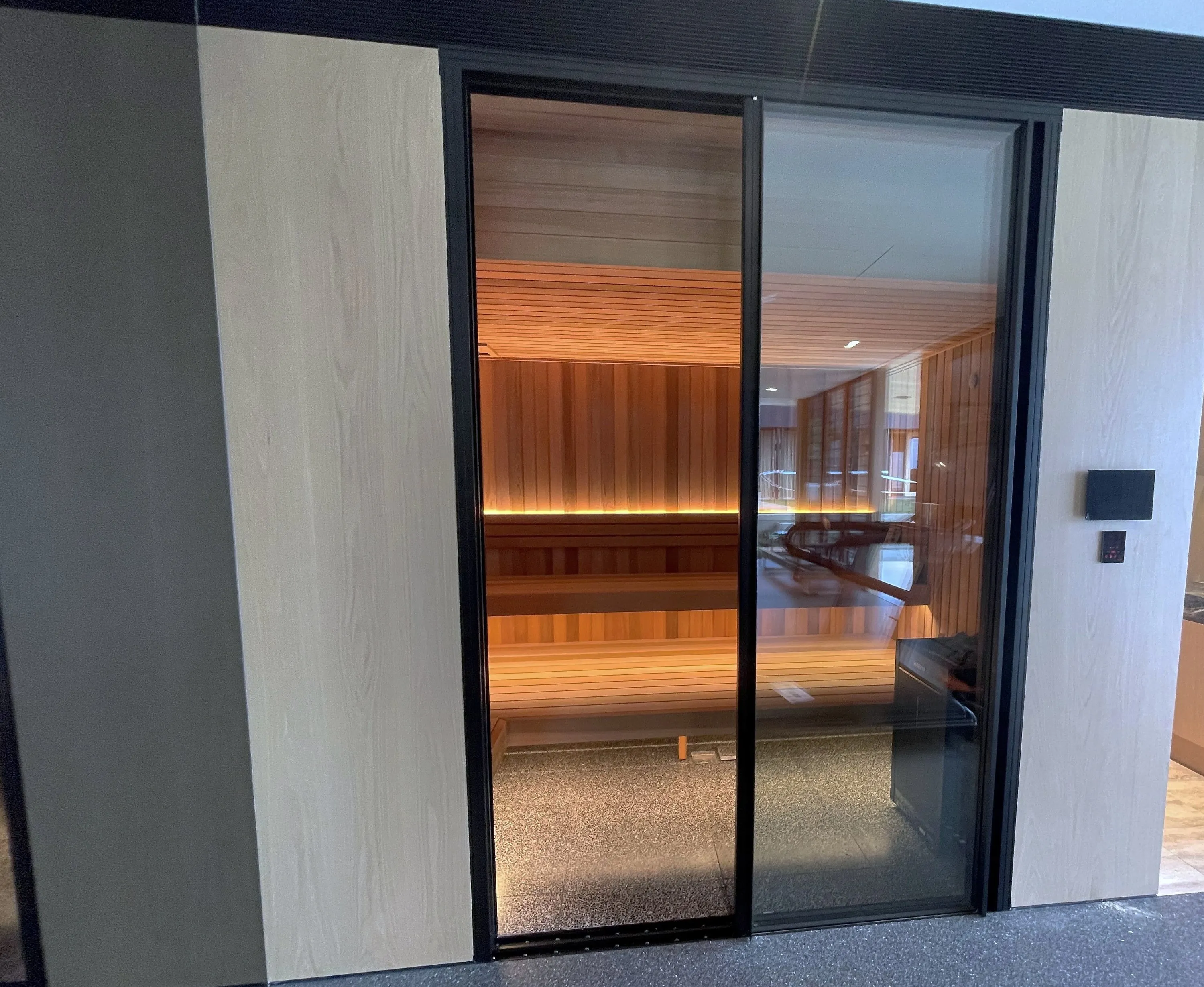
The short answer
A well-chosen sauna heater is sized for the room’s corrected volume, carries enough stone for the löyly you want, suits how often and by whom the sauna is used, and is controlled, supplied and installed to its manufacturer’s requirements.
Almost every number that matters (volume range, clearances, stone size and quantity, sensor position, electrical configuration) is specific to the heater model. This guide explains the principles. The selected heater’s documentation always has the final say.
Room volume, and why it matters
A sauna heater warms a body of air and the surfaces around it. The bigger that body of air, the more heat is needed to bring it up to temperature and hold it there. That is why every heater manufacturer rates each model for a minimum and maximum room volume in cubic metres, rather than by floor area.
To find the volume, multiply the internal length, width and height of the finished room. Ceiling height matters as much as floor size: a modest ceiling keeps the hottest air near the upper bench and reduces the output needed. Harvia recommends no more than 1,200 mm between the upper bench and the ceiling.
Those rated ranges assume a well-insulated room lined with timber panelling. Anything else in the room changes the calculation.
Glass and other uninsulated surfaces
Glass, brick, concrete, tile and stone absorb and lose heat far more than an insulated timber wall. Manufacturers allow for this by adding extra “virtual” volume for each square metre of such surface before choosing a heater.
Harvia’s method (as published in its current heater manuals, such as the Cilindro):
- add about 1.2 m³ to the room volume for each square metre of uninsulated wall, such as brick, glass block, glass, concrete or tile;
- if the room has log walls, multiply the room volume by 1.5.
Harvia’s own example: a 10 m³ room with a glass door needs about the same heater output as a 12 m³ room.
Other manufacturers use different allowances. Several publish the same 1.2 m³ per square metre. One adds 1.5 m³ per square metre of uninsulated brick, tile or glass. Another adds 1 m³ per square metre of glass, tile or stone, and more for solid concrete or stone walls. Some heavy-duty heater makers publish no glass factor in their manuals, but list ignoring large glass areas as a common planning mistake.
Why this matters: glass and masonry keep drawing heat out of the room for as long as the sauna runs. A heater sized only on the timber room can sit at full output, heat slowly and leave the stones short of heat for löyly. On a glass-fronted room, especially a small one, the allowance can move the selection up a heater size. Final sizing always uses the method published by the maker of the heater being specified: the manual for the selected model governs.
Heater output and room volume
Each heater’s rated volume range is printed in its manual and data sheet. These Harvia examples show how the ranges work:
| Harvia model | Type | Output | Rated room volume | Stones |
|---|---|---|---|---|
| Vega BC45E | Wall-mounted | 4.5 kW | 3–6 m³ | 20 kg |
| Cilindro PC90E | Tower | 9 kW | 8–14 m³ | 90 kg |
| Virta HL110 | Floor-standing | 11 kW | 9–18 m³ | 70 kg |
| Legend Pro PO165E | Large tower | 16.5 kW | 16–35 m³ | 220 kg |
Two things stand out. Each heater covers a range, not a single size. And the ratio of kilowatts to cubic metres is not constant: it changes with room size and heater design. There is no reliable universal “kW per cubic metre” rule, so the selected model’s table is the only sound reference.
Why undersizing and oversizing both cause problems
- Undersized: the room heats slowly, the heater runs at full output for long periods, and the stones cool quickly when water is thrown.
- Oversized: the air reaches temperature before the stones are fully heated, the thermostat cycles off, and water thrown on the stones can run straight through without producing good steam. A room smaller than the model’s minimum rated volume is outside its rating altogether.
Stone capacity, heat and löyly
The stones store the heat that turns ladled water into steam: löyly. Stone loads range from around 20 kg on small wall heaters to more than 200 kg on large tower heaters.
- More stone stores more energy for repeated throws and recovers more steadily between them, at the cost of a longer heat-up. Harvia describes high stone-mass heaters as giving softer löyly, and compact wall heaters as suiting people who like the heat drier and sharper.
- Less stone heats up sooner but has a smaller reserve, so a heavy throw cools it faster.
- Ladle size is set by the heater. Harvia’s manuals limit each throw to 0.2 litres. Too much water at once does not evaporate and can splash scalding water onto bathers.
Small or large stone mass
| Small stone mass | Large stone mass | |
|---|---|---|
| Typical load (Harvia examples) | About 20 kg (Vega wall heaters) | 90 kg (Cilindro PC90E), 140 kg (Virta Pro HL220), 220 kg (Legend Pro PO165E) |
| Heat-up | Sooner | Longer, because the stones must be heated through |
| Löyly | Drier and sharper, as Harvia describes it | Softer and more sustained |
| Recovery between throws | Smaller reserve; heavy throws cool the stones quickly | Large reserve; steadier through repeated throws |
| Stone size | Mostly 5–10 cm | 5–10 cm on most Harvia heaters; 10–15 cm on Virta, Virta Pro and Legend Pro PO165; a mix of 5–10 and 10–15 cm on Legend Pro PO11 |
| Upkeep | Quick to lift out and rearrange | More stone to lift out, check and rearrange |
| Suits | Small home rooms, shorter sessions | Larger rooms, frequent löyly, busy commercial rooms |
Why this matters: neither is better in general; the stone mass should match how the room is used. A big heater fired up for a quick weeknight session spends much of it heating stones, while a small heater in a busy room cannot keep up with repeated throws.
The stone load is also part of the heater’s safety design: the stones shield nearby timber from the elements and let air flow through the heater. See Sauna stones below.
The main heater types
Most saunas use an electric heater: resistance elements inside a body of stones. Types differ mainly in shape, stone mass and position.
| Type | What it is | Where it suits |
|---|---|---|
| Wall-mounted | Compact stone basket on a wall bracket, often available with built-in controls | Smaller home saunas where floor space is tight |
| Floor-standing | Box or cylinder of stones on legs, with the elements among or beside the stones | Medium to larger home rooms; some models are rated for commercial use |
| Tower or high stone-mass | Tall cylinder holding a large stone load | Feature heaters in premium rooms; softer, more sustained löyly |
| Heat-storage | Insulated body with a lidded stone chamber kept hot on low standby power | Frequent, unplanned home use where quick readiness matters |
| Concealed | Heater behind a dividing wall or under a bench, with heat released through a grille | Minimal architectural interiors |
| Commercial | Higher output, rugged build, often with elements separated from the stones and service access | Hotels, gyms, day spas and shared residential facilities |
Combi heaters add a water evaporator for lower-temperature, higher-humidity sessions. See Combi heaters below.
Heat-storage heaters trade standby energy for convenience. Harvia quotes a ready time of roughly 5–15 minutes from standby for its Forte, with standby use of around 4–6 kWh a day.
Concealed heaters need particular care. A standard heater must not be placed in an alcove or under a bench unless its manufacturer has designed and approved it for that position.
Wood-fired stoves and infrared emitters are separate categories. Wood-fired stoves bring flue, clearance and approval questions of their own. Infrared emitters warm people with radiant panels rather than heating stones and air, produce no löyly, and are not sized the same way as sauna heaters.
Combi heaters
A combi heater is a stone heater with a built-in water evaporator. It can run as a normal sauna, or cooler and more humid for a gentler session. Harvia’s Virta Combi is the example used here; other combi heaters differ in detail.
- The evaporator holds about 5 litres, enough for roughly 2 hours of continuous steaming.
- Fill it while the heater is cold, before the session.
- For good humidity, Harvia suggests keeping the room at about 40 °C and running the evaporator for about an hour.
- Drain it after every use, once it has cooled. As water boils off, the impurities left behind become more concentrated, and draining removes them. Automatic-fill versions (SA models) top up from a water connection, and Harvia asks for a floor drain in the sauna and/or washroom in case of leaks.
- Dry the room thoroughly afterwards, with the heater on and ventilation at maximum, then switch off.
- Descale the evaporator with a household kettle or coffee-maker descaler, as the manual directs.
- It needs a combi control with a steamer output. On Harvia’s Xenio, the temperature and humidity settings together cannot exceed 140 (for example 60 °C and 80 % relative humidity), and the steamer stops if the water runs out. The compatible control is confirmed for the selected model.
Why this matters: a combi heater adds water to the room. Water left standing in the evaporator, or a room left damp, brings scale, odour and timber problems, so the drain-and-dry routine is part of owning one.
| Standard heater | Combi heater | Hybrid sauna | |
|---|---|---|---|
| What it is | Stone heater | Stone heater with a built-in evaporator | Stone heater plus infrared emitters in one room |
| How humidity is made | Water thrown on the stones | Evaporator, plus water on the stones | Water on the stones; the infrared adds none |
| Water supply | None | Filled by hand, or a water connection on auto-fill models | None |
| After use | Ventilate and dry | Drain the evaporator, dry the room, descale as needed | Ventilate and dry |
| Control | Built-in or separate | A combi control with a steamer output | Harvia describes the heater and panels as controlled separately |
A combi heater is not a hybrid sauna. Our traditional, infrared and hybrid guide explains hybrids. Whether a heater and infrared emitters may run at the same time is set by the manufacturers of the exact products.
Built-in or separate controls
Heaters are controlled in one of two ways:
- Integrated controls: a thermostat and timer on the heater itself. Simple and self-contained, but the controls are inside the hot room.
- A separate control unit: a wall-mounted panel, usually outside the sauna, working with a temperature sensor in the room. It allows digital setpoints, pre-set timers, lighting and fan outputs and, on some systems, app control.
Many heaters come in both forms. Harvia, for example, sells the Vega BC60 with switches on the heater, and the Vega BC60E for use with a separate control unit. Some heaters, including most commercial models, work only with a separate controller. The controller must be one the heater manufacturer lists as compatible, and it may need its own position and supply planned with the room.
Every heater relies on an overheat protector that cuts power if temperatures rise too far. Harvia says only a person authorised for electrical work may reset it, once the cause has been found. Crumbled or packed stones, a heater left on unused for a long time and a displaced or damaged sensor are common culprits.
Our sauna controls guide covers sensor placement, overheat protection, heating-time limits, remote and app start, power units and commercial controls in detail.
Residential or commercial duty
Manufacturers state who each heater is designed for. On Harvia’s product pages, every heater has a user group: households, professionals, or both. A household heater is not a cheaper version of a commercial one; it is designed for a different pattern of use.
| Residential heater | Commercial heater | |
|---|---|---|
| User group (Harvia) | Households | Professionals |
| Use pattern | A session or two at a time, a few times a week | Many hours a day, most days, with frequent löyly |
| Construction | Built for home use | Heavier construction; some makers use reinforced stainless steel and solid busbar wiring on heavy-duty models |
| Stone mass | About 20–90 kg on typical Harvia home heaters | 140 kg (Virta Pro HL220) to 220 kg (Legend Pro PO165E) |
| Stones and elements | Elements usually sit among the stones | Harvia’s Virta and Virta Pro separate the elements from the stones and have a front service hatch; some heavy-duty heaters from other makers keep the stones in a separate store so elements can be replaced without removing them |
| Room and clearances | Set for each model | Larger clearances and taller rooms; Harvia’s Virta Pro HL220 needs a ceiling of at least 2,100 mm |
| Controls | Built-in, or a single control unit | A separate control, often with a power unit or extension, and longer heating-time settings under supervision rules |
| Stone care (Harvia) | Rearrange at least yearly | At least yearly and more often with frequent use; other makers publish commercial intervals of a few months, or by operating hours |
| Guarantee (Harvia heaters and controls) | 2 years for families | 1 year for building residents; 3 months for institutions or commercial facilities |
| Supply | Some models are offered single-phase | Commonly three-phase; Harvia lists the Virta Pro HL160 as 400V 3N~ only |
Why commercial heaters are built differently
- Heavier construction, because the heater runs hot for most of the day, every day, and is used by far more people.
- More stone, so the heater keeps producing good löyly through repeated throws from a full room and recovers between them.
- Elements that can be reached for service, because a commercial room cannot close for days while a heater is emptied and pulled off the wall. A front hatch, or a stone store kept apart from the elements, shortens that downtime.
- Separated stone and element designs on some heavy-duty models also keep crumbling stones from settling around the elements, which helps airflow and element life. Not every commercial heater is built this way.
- Guarantees set by user group reflect the heavier duty. A household heater put into a commercial room can fall outside its guarantee terms.
One heater per room
Harvia’s manuals, including those for its commercial Virta Pro and Club Pro heaters, allow only one electric heater in a sauna room. A large room gets one larger heater rated for its volume, not two smaller ones. Some other manufacturers allow several heaters in one room, with additional safety limiters. The manual for the selected heater governs.
Why this matters: one correctly sized heater keeps the heat even and the safety design as the manufacturer tested it, with one sensor and one overheat protector watching one heater.
What else changes with commercial duty
- On-time limits. Manufacturers set maximum operating times by reference to the international safety standard for sauna heaters, IEC 60335-2-53. Harvia’s Xenio allows 1–6 hours for family saunas, and its Fenix controls can be set to 12, 18 or 24 hours for commercial use. A heater run beyond the factory timer must be constantly supervised. Other manufacturers commonly limit private saunas to 6 hours without automatic restart.
- Stone wear. Stones in a heavily used heater break down far faster and need checking much more often.
- Remote start. Harvia permits remote or app start only where a cover sensor or door switch is fitted, or the heater has passed the covering test the control’s manual names, and the room must be checked before a remote or timed start.
Our commercial guide covers operation, supervision and maintenance, and the controls guide covers time limits and remote start.
Heat-up
Harvia’s manuals give about an hour for a correctly sized heater in a properly insulated room, with the stones reaching temperature at around the same time. Harvia also notes that a heater typically runs at full power for the first 30–40 minutes, then at about half power to hold the temperature. High stone-mass heaters can take longer: one maker of pillar heaters quotes 60–75 minutes. Heat-storage heaters on standby are much faster.
Heat-up depends on correct output for the corrected volume, insulation and glazing, the starting temperature (outdoor rooms take longer), ventilation, sensor position and the stones. In a Harvia test, a room was about 10 °C cooler after an hour with tightly stacked stones than with fresh, loosely laid ones.
Ventilation
A sauna needs fresh air, and the heater’s manual sets out how it should enter and leave. Manufacturers differ: some place the supply below or beside the heater, others above it when a fan provides the exhaust. Incoming air must also be kept away from the temperature sensor (Harvia specifies about 1,000 mm from an undirected vent, or 500 mm from one directed away, and several other makers give the same distances), or the sensor reads low and the heater runs longer than it should.
Our sauna ventilation guide explains the principles.
Electrical supply
A sauna heater is a substantial fixed electrical load, so the supply is planned early, alongside the heater choice.
- Australian supply is nominally 230 V single-phase and 400 V three-phase, though many people still call it 240 and 415 V.
- The exact supply depends on the model and its output. Smaller residential heaters may be available in single-phase versions, depending on the model. Larger residential and commercial heaters commonly need three-phase.
- Some models are offered in more than one electrical configuration. Harvia, for example, publishes the electrical group options for its Vega BC60 (6 kW) as 230V~ / 230V 3~ / 400V 3N~, while its commercial Virta Pro HL160 (16 kW) is listed as 400V 3N~ only. These are Harvia’s own notations for those models; other heaters differ.
- In Queensland, “single-phase” is not the whole answer. The Queensland Electricity Connection Manual (QECM, Version 4), published by Energex and Ergon Energy Network, may limit how much some switched single-phase equipment can draw in a home’s installation. So a heater offered in a single-phase version is not automatically suitable for a particular house. Your electrician checks the selected heater against the connection rules, the site’s supply and the manufacturer’s data, and confirms whether it can be single-phase or needs three-phase or the distributor’s agreement. Larger heaters commonly need three-phase.
- Controls may be separate. Where a heater uses a separate control unit, the controller, sensor and any lighting or fan outputs are part of the electrical design too.
A licensed electrician confirms the final supply, cabling, protection and connection to AS/NZS 3000 and the heater manufacturer’s installation instructions. BSC selects the heater and controls to suit the room and the project, and coordinates with the electrician so the supply is planned before the room is built.
Clearances and guards
Minimum distances from the heater to walls, ceiling, floor and benches, minimum ceiling heights, and the design of any guard rail are set by the manufacturer for each model. They vary considerably, even within one brand, and the installation manual for the specific model governs. Harvia permits only one electric heater per sauna room; some other manufacturers allow more with additional safety limiters. Floors under and near the heater should be heat-resistant, because hot stone fragments can fall out.
Compliance and licensed trades
Heater supply, cabling, protection and connection must be determined and installed by a licensed electrician to AS/NZS 3000 and the manufacturer’s installation manual. Sizing, clearances, guards, sensor positions and ventilation follow the selected heater’s documentation. Wood-fired stoves raise building, flue, council and, on bushfire-prone land, bushfire questions that must be resolved with the building certifier, council and a licensed installer.
Sauna stones
Stones are a working part of the heater, not decoration. They store the heat that makes löyly, let air flow through the heater and shield nearby timber from the elements. The wrong stones, or good stones stacked badly, make the elements run hotter and can damage them.
The essentials:
- Use the type and size your heater specifies. Approved types are dense natural stones such as olivine diabase, peridotite, olivine and vulcanite, and sizes run from about 5–10 cm to 10–15 cm depending on the heater. Never use stones collected from a garden or river, and use ceramic stones only where the heater maker approves them.
- Load them loosely, by hand, largest at the bottom, with the elements covered but not wedged, and no high pile on top.
- Expect them to wear out. Heating, cooling and water crack and crumble them. Harvia asks for the stones to be rearranged at least once a year, more often with frequent use; commercial heaters need far more frequent checks.
- Use clean household water, never pool or spa water or seawater, and only scents made for saunas.
Our sauna stones guide covers Harvia’s stone types and sizes by heater, rounded or angular stones, step-by-step loading, the signs of wear and replacement intervals in full.
Coastal and outdoor saunas
Manufacturers warn that sea air and humid climates can corrode heater metalwork. For coastal Queensland sites and outdoor rooms, discuss heater finish and placement early.
Questions to ask before choosing a heater
- What is the room’s volume, and how much glass, masonry or tile does it include?
- What does this manufacturer add for those surfaces, and where does the corrected volume sit in the model’s range?
- What kind of löyly do we want, and how much stone mass does that suggest?
- How often, and how spontaneously, will the sauna be used?
- Is the heater rated for the intended user group, residential or commercial, and what on-time and supervision rules follow?
- Built-in controls or a separate control unit, and will the sauna be started remotely?
- What supply is available on site, and which of the heater’s electrical configurations suits it, as confirmed by a licensed electrician?
- What clearances, ceiling height, floor finish, ventilation and sensor positions does this model require?
- Which stones does this heater require, and who will check and replace them?
How we approach it
The heater shapes the room around it: its size, glazing, ventilation, bench layout and electrical planning. If you have plans or a concept, we can work through heater selection with you and explain how the options affect the design.